


Amathus Capital focuses on a blend of development and buy-to-let assets for a mixture of income and capital growth. To achieve this, the Fund applies the following investment strategies.
Growth
Using the seed portfolio as an example, the Growth strategy’s focus has historically been on mid-level, under-utilised, multi-unit assets, with strong potential for capital growth through refurbishment, development and/or re-positioning. A bottom-up approach has offered the seed portfolio good opportunities for capital growth. The Fund aims to continue to apply this strategy.

Turnpike Lane
A good example of this strategy from the seed portfolio is a property in Turnpike Lane. The property was bought from Haringey Council in 2013 as an old care home. A study was carried out to work out the best use for it and a planning permission was obtained for re-positioning the asset into residential flats by extending the property and converting it. The building was then broken up and sold on a unit by unit basis to investors and end users by 2015. Cost of purchase & re-development: £1.1m. Sale proceeds: £2.5m. Return on capital investment: 261.7 per cent.
Growth to Value
When investments from the growth strategy, through repositioning, are deemed to be strong performers for the value strategy, then these assets may be transferred to the value element of the portfolio instead of being sold.
An example of this strategy from the seed portfolio is a property in Hampstead (please see the photo at the top of the page).
The property was bought at auction after the 2008 – 2009 credit crunch. Due to the high risk nature of the tenant (sole trader restauranteur) many investors shied away from the property. This was seen as an opportunity in that re-positioning part of the commercial element to residential could better meet local demand. After purchase negotiations were entered into with the commercial tenant (who occupied three floors of the property as a restaurant) for the surrender of their lease. The asset was repositioned to provide a smaller retail unit on the ground floor and five newly refurbished flats above. Cost of purchase & re-development: £1.7m. Fair Value (March 2020): £3.3m. Current rent per year: Commercial £60,000 (15 year contract expiring 2033) / Residential £76,800. 3 year average gross rental yield: 13.7% on capital investment
Value
Assets held as part of this strategy range from high-end 5-6 bedroom family homes in the South-East to 1-3 bedroom apartments and houses in North London as well as small shops or offices on high streets in outer London (Zones 2-6).
Looking at the South East in more detail, portfolio assets situated here are typically high-end family homes which mostly house corporate executive tenants. Cobham, for instance; given its proximity to central London and a number of prominent public schools, has historically offered solid rental returns/capital growth and continues to attract top executives and their families.
Two examples of this strategy are,
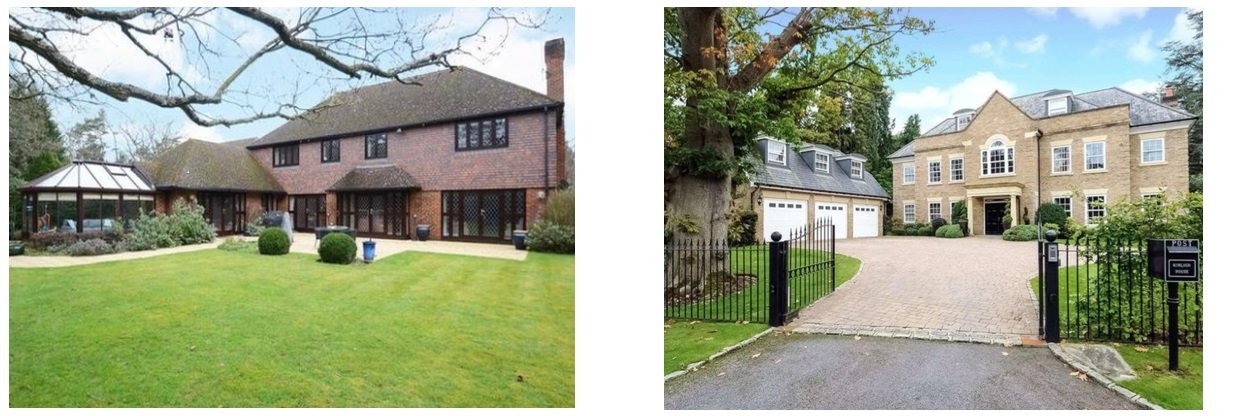
Cobham and Sunningdale
(a) a large family home in Cobham, Surrey, bought in 2010 for £1.5m. This house was valued at £2m in March 2020 and yields a monthly rent of £5,950. The property produces a 3 year average gross rental yield of 9.0 per cent on capital investment (3.5 per cent on Fair Value).
(b) a large family home in Sunningdale, Berkshire, bought in 2010 for £2.6m. This house was valued at £3m in March 2020 and yields a monthly rent of £10,000. The property produces a 3 year average gross rental yield of 9.3 per cent on capital investment (4 per cent on Fair Value).

