
But critics say it is just an excuse to hunt down drug users
By Andria Kades
After almost eight years of discussions, Cyprus will by the end of the month begin carrying out drug tests on drivers – dubbed narcotests – aimed to catch those behind the wheel under the influence of drugs.
Heralded by the government as a preventative measure to reduce road deaths and accidents, it has come about after EU recommendations to make the streets safer, the justice ministry said.
Set to begin on January 25, narcotests have not been warmly welcomed by all members of the public with reactions ranging from concerns on how far back the narcotest can detect if a driver took drugs to others branding the law unconstitutional.
Officers pulling someone over will provide the driver with a strip of cloth to put in their mouth.
According to traffic police deputy chief Haris Evripidou, the narcotest will show positive or negative for five specific drugs – cannabis, opioids, cocaine, amphetamines and metamphetamines.
The initial test will not reveal which drug it has detected, only whether it has found any traces of the above.
If positive, the officer will first ensure the driver does not continue driving – by taking their vehicle to a police station or allowing someone else to drive the car if legally allowed to do so for instance – and a second sample of saliva will be collected and sent to the state laboratory, which will identify which drug has been detected.
“Comments by Justice Minister Ionas Nicolaou that a blood sample will be taken were wrong. That had been one of our initial thoughts but it was not included in the final piece of legislation,” Evripidou said.
Within 15 days, the state laboratory will have the results of the tests and from there on, if the results confirm the driver has broken the law, the case will go to court.
Drivers can face a penalty of up to €3,500 in fines and a three-year imprisonment. They also risk losing their driving licences for a maximum of three years and earning three to six penalty points.
If a driver refuses to give a saliva sample, they will be tried in the same way as if the narcotest had been positive.
Revenue from drug-related driving convictions will be paid into a special fund to tackle drug addiction.
The burning question however is how far back the narcotest can find traces of drugs.
“If I go to Amsterdam where it is legal to smoke weed and come back to Cyprus, I haven’t broken the law here where cannabis is illegal. THC (tetrahydrocannabinol) however will be in my bloodstream for weeks,” one user who wished to remain anonymous said.
The key difference however is that in saliva samples, THC does not remain for anywhere near the amount of time THC stays in the blood.
“The narcotest will be positive if the drug was taken in the last several hours. If the person is a regular user however, the sample might be positive a day or two after they take the drug,” Evripidou stipulated.
Friends of Cannabis association however have been highly critical of the law from the outset not only branding it as unconstitutional but saying it was an attempt by the government to deter the public from “an innocent drug like cannabis”.
While it is obviously targeting other drugs too, co-founder of the association Solon Antartis, told the Sunday Mail that the government should not be able to obtain any person’s DNA without a court order.
“After discussions with different lawyers, we have come to the conclusions that this is unconstitutional.”
The association is willing to take the steps and take the case to court or the European Court of Human Rights but is waiting for the first narcotest to happen so it can proceed.
The justice ministry however said the samples are not taken for DNA purposes and as such “there is no case of it being unconstitutional.”
Evripidou also added that the saliva sample will be destroyed 30 days after it was taken.
Another criticism is that the narcotest is markedly different from an alcohol test in one crucial degree. You are allowed to drink a certain amount of alcohol and still drive and will only be prosecuted if a breathalyser measures you as being over the legal limit. With a narcotest, there is no limit. You simply can’t have any in your system. If you have taken drugs, you will test positive.
This has led to accusations that the test is not about driving impaired as much as it is prosecuting drug users.
Other concerns have also come to light – people on legal medication which contain opioids.
“We’ve thought of everything,” Evripidou said.
In such cases, the driver will inform the officer of the medicine they are on and a note will be made on the saliva sample. The state lab will confirm if this is the case and be able to differentiate between an illegal drug such as heroin for instance, or a prescription drug like oxycodone.
According to Evripidou, the reasoning behind introducing the narcotest has been “a worrying, increasing trend in the number of road deaths of people who had taken drugs – often in combination with alcohol.”
“Until now, we don’t know how many accidents were caused by drugs because we had no way of testing it. The only ones we knew about were those that died and tests were undertaken as part of their autopsy,” he said.
For instance, someone may have been pulled over and fined just for speeding. The reason they were speeding however could have been because they had taken drugs, Evripidou said.
Similarly, someone who has taken cannabis may have slower reactions, he added.
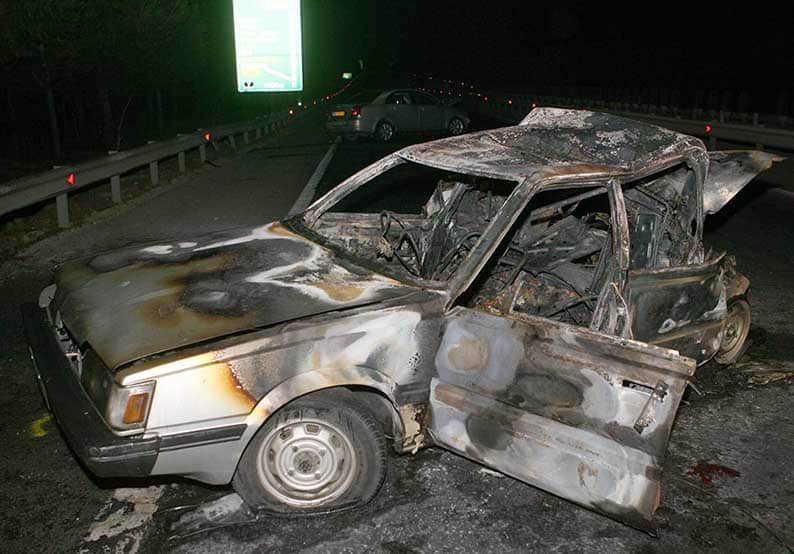
Officers had no legal way to test it on the spot and as such, the only results are those that resulted in fatal accidents.
In 2014, there were 11 road deaths where victims were found to have taken drugs. It remained the same in 2015 and in 2016 had gone up to 16.
In 2017, the number fell to 13 road deaths.
Though this does not reveal a particular increase, Evripidou said since 2014, of the 400 blood tests taken in road deaths, 25 per cent were positive for drugs.
“This is still a very significant number, we’re talking about a quarter of them.”
It is not clear how many of those had taken just drugs or a combination with alcohol.
The penalties for drink driving are lower at present but this is only because the legislation is older, Evripidou said.
There are different levels for the fines and sentences for drink driving but the maximum is a €5,000 fine and two years in prison, he added.
“We want the penalties for drunk driving to go up as well.”
When a case goes to court after the state laboratory has confirmed a driver was under the influence of an illegal drug, it will be up to the judge to decide the severity of the sentence.
This means, there is no automatic stricter penalty if someone used a class A drug such as heroin as opposed to cannabis which is a class B drug.
What remains to be seen however is how long the cases will take to be tried. Cyprus’ judicial system is already clogged up and Evripidou said traffic cases usually take up to six months.
“Our aim is not to punish but to prevent.”
The legislation on narcotests had been in parliamentary committees since 2010 and passed into law in 2016

