
By Annette Chrysostomou
There are currently thousands of seed banks around the world. and their contents – millions of seeds – are most likely of vital importance to our species and the health of the ecosystems we live in. As the wild areas of our planet decrease, we risk biodiversity loss on an unprecedented scale, and the seed banks at least ensure that some of it is preserved for future generations.
Cyprus is doing its part by conserving thousands of endemic seeds. The only seed bank on the island is located at the Agricultural Research Institute in Athalassa, Nicosia.
The researchers are passionate about the importance of saving all these seeds.
“It is like archaeology to me,” agricultural researcher at the institute Angelos Kyratzis said. “When you save an ancient seed it is like saving a sculpture. It represents the culture, tradition and history. Different types have different traits and intense flavours, like tomatoes years ago for example.”
Farmers’ union (EKA) leader Panikos Hampas recently proposed the creation of a special area in Troodos for the safekeeping of the Cypriot seed bank to the president and agriculture minister, saying it should be transferred to a shaft in the Amiantos mines.
This is a proposal which is not on the cards, the Agricultural Research Institute said. “The seedbank is a scientific undertaking,” director of the institute Dora Chimonidou said, “and has to be in a scientific environment”.
The importance of the seedbank is clear. One of the aims is to conserve local landraces, varieties with a long history in Cyprus. “There are varieties which have grown in the Nicosia area for thousands of years, and they have it in their genes to withstand the weather condition in this area,” Kyratzis explained.
The government institute also conserves endemic and rare plants, in cases reintroducing or reinforcing their presence in certain region of the country. This is especially important at a time when climate change not only threatens species in Cyprus, but in Europe and other parts of the world. This means the seed bank is not only important for Cyprus, but for the rest of the world as well.
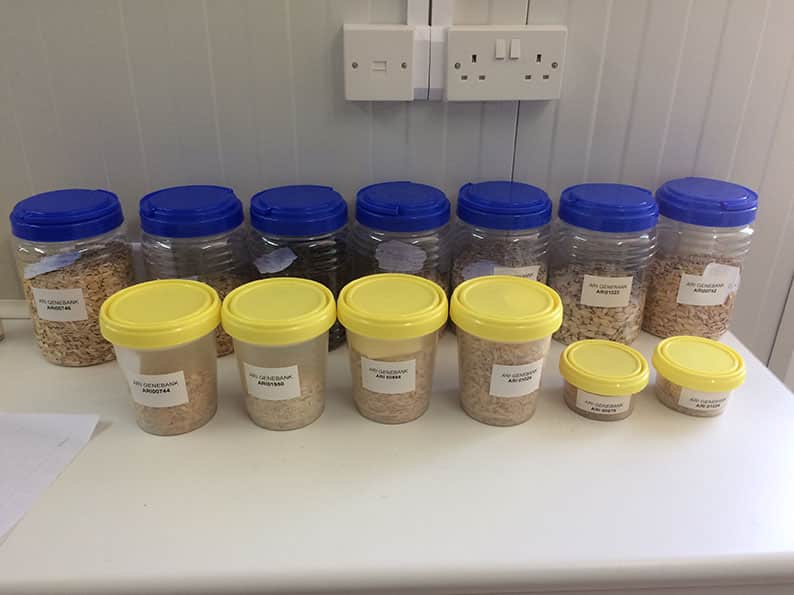
Stored are also a number of crop wild relatives, wild plants genetically close to industrial crops. Altogether, 11,000 types of wheat are stored at the gene bank. Then there is the need to store crops for various uses, aromatic, medicinal and ornamental so they can be offered to the local market. Those local varieties are unlike ones from other countries, giving them a competitive advantage.
Some crops such as carob trees and pomegranates are underutilised and their seeds must also be saved.
Altogether, institute stores 13,370 samples of a particular population or ‘accessions’ as the experts call them from more than 404 different plant species.
Researchers also aim to create awareness, hoping that global trends towards uses of local varieties of flora will mean more interest in this country.
In order to do all this, the institute works together with other departments and organisations, both local and international. The forestry department often helps with the collection of seeds in areas where their officers are knowledgeable. Projects often involve European funding.
Lately, the institute has been part of several international projects. One was ‘Ensuring the survival of endangered plants in the Mediterranean’, a three-year project funded by the Mava foundation which comprised six Mediterranean islands. For this project Cyprus contributed by collecting 160 endemic threatened species from 2011 to 2013.
Another one is ‘Global Tree Seed Bank Project’, a global initiative which will secure the future of more than 2,000 of the world’s rarest, most threatened and most useful trees. It is funded by the Garfield Weston Foundation and it is coordinated by the Millenium seed bank, potentially the world’s biggest seed bank.

The process
Most people are probably unaware of how much hard work and scientific knowledge is needed to successfully conserve and germinate the seeds.
First, they need to be separated from debris surrounding them. After they are crushed, a seed blower separates debris and empty seeds from the heavier seeds.
After they have been cleaned, they have to be counted with a seed counter.
Before they are stored, they also need to be dried to increase their longevity. This involves a spell in a room at 15 per cent humidity.
Next the items are divided into three parts. One is stored in freezers at a temperature of -20 degrees. This is called the ‘base collection’, meaning the items will simply be stored and not opened again.
The second part is refrigerated at 2 degrees. This is the ‘working collection’, they are taken out for regeneration at a later stage.
A third collection is sent to other seed banks such as the Millenium seed bank to ensure that species will not be completely lost in case the Cyprus collection is destroyed by an earthquake or during a war.
Maybe the trickiest part is the germination, as part of the reason for the disappearance of a plant is that it has stopped germinating and many species will not germinate again once collected.
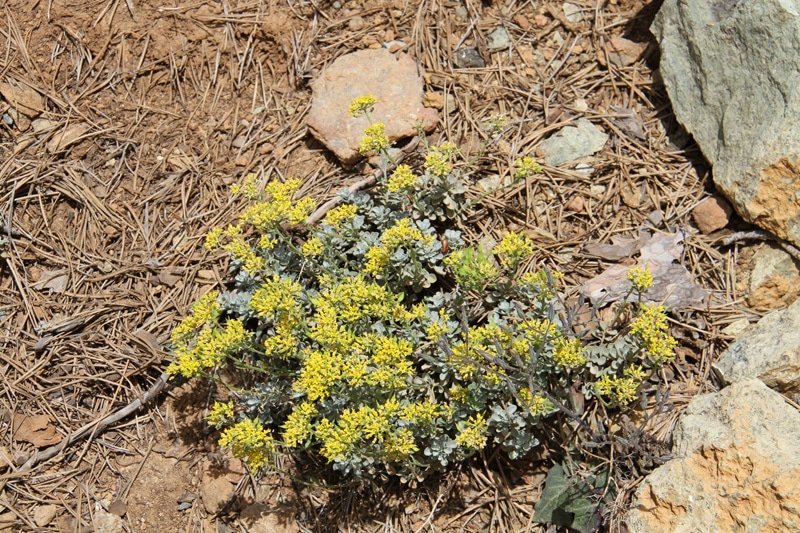
One success story is the germination of one of the rarest plants in the world. Crypsis hadjikyriakou only grows on a few square metres in an area of Troodos. It had been tried many times before without success, and only after many trials did the researchers in Cyprus find that they needed to store them for eight months before this could be done. The whole process was extremely difficult as due to the plant’s rarity no documentation existed.
Seed bank facts
Aiming to be the most comprehensive of the thousands of seed banks, the Millennium seed bank housed at the Wellcome Trust Millennium Building located near London is the largest in the world, providing space for the storage of billions of seed samples in a nuclear bomb proof multi-storey underground vault. Its ultimate aim is to store every plant species possible.
Though Amiantos is not an option, wherever possible it makes sense to store the seeds in a place which is naturally cold. One example is the Svalbard Global Seed Vault, also known as the Doomsday Vault, built inside a sandstone mountain in a man-made tunnel on the frozen Norwegian island of Spitsbergen. Part of the Svalbard archipelago, the island is about 1,307 kilometres from the North Pole. It is not only cold but also designed to survive catastrophes such as nuclear war and a world war. The area’s permafrost will keep the vault below the freezing point of water, and the seeds are protected by one-metre thick walls of steel-reinforced concrete.

