
When Eleni Philippou attended her grandmother’s funeral last week, the reality of life under coronavirus hit home hard
Until a couple of weeks ago, my only reason for requesting government permission to leave the house had been number 6 on the list, i.e. to get some physical exercise. It was with a sense of dread and disbelief that I was suddenly forced to use number 7: movement for the purpose of attending a ceremony (e.g. funeral, wedding, christening) of first- and second-degree relatives.
My grandmother died of natural causes, leaving behind this messy world in which we currently find ourselves. Beyond the grief and memories, the news of her death also raised many questions about what would happen next.
In a time when being around other people is prohibited, who would go and collect her lifeless body and sort out her belongings? How many relatives were allowed to visit her house?
The last time I saw my grandmother was some time in February. After that, and as the virus cases began growing, everyone kept their distance from her house, fearing that an asymptomatic carrier could pass it on to her.
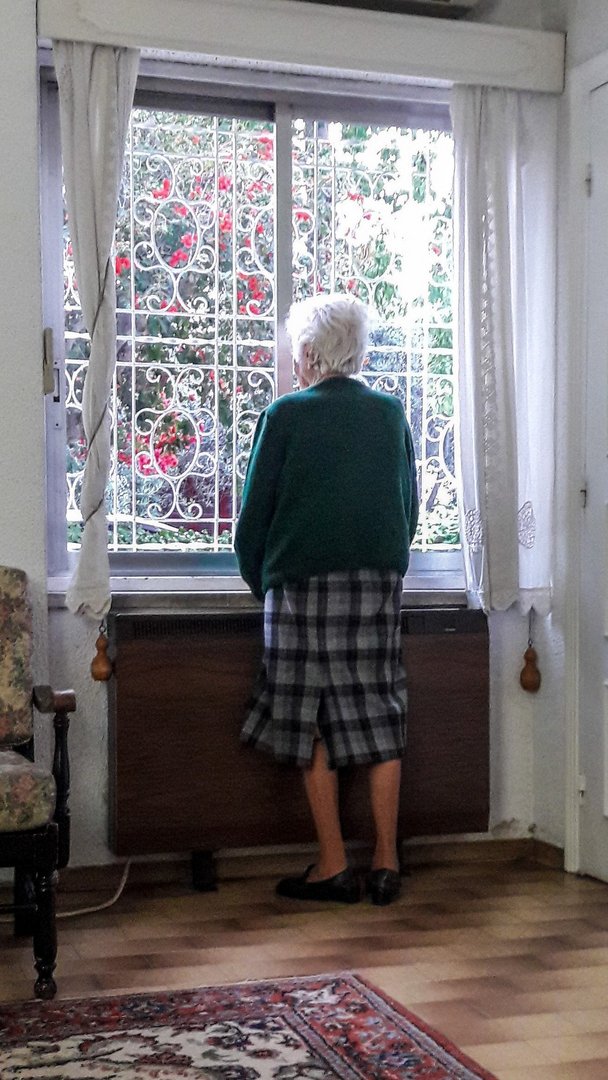
Under normal circumstances, I’d visit her every other week. Having a conversation was a challenge – she was in her 90s, with Alzheimer’s – but she was always happy to see us and that was reassuring.
On the morning of her death, I sat on the couch confused and in need of some reassurance. Was I allowed to visit the body before they took her away? Would a funeral take place? Who could go?
I wanted to see her. I texted number 5 (movement with the purpose of assisting people who are unable to protect or take care of themselves). When I arrived, a few of my aunts and uncles were already there, dressed in gloves and masks, standing at a fairly safe distance from each other.
I thought of touching her hand but wasn’t sure whether I was allowed. I hadn’t been near anyone that I don’t live with since early March. Could I now? I decided not to approach the bed, I just watched and gave her a soft smile from behind my mask.
As is usual in Cyprus, the funeral was to be held the following day – but for only 10 people, as stated in the relevant decree. I had initially assumed my grandmother’s funeral would be a busy affair. She’d been active in the Red Cross after 1974, and a staunch supporter of the activities of Pasykaf; her social circle was vast. At 82, she’d received an award for being the oldest volunteer still helping with blood donations after 35 years. It was only natural to imagine that all these people would want to honour her departure.
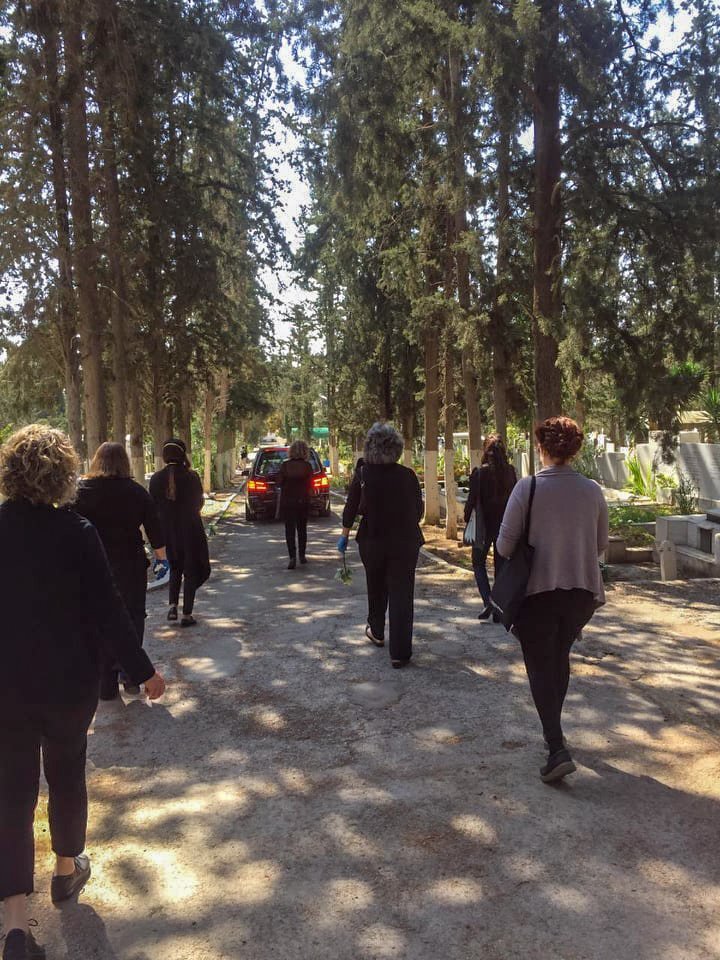
When the time came, however, the circumstances were very, very different. Only immediate family could attend the funeral, but even that came out at more than the permitted 10 people. The priest told us that 10 could enter the church for the ceremony, and the remaining three to four would have to stand outside.
Waiting for the coffin to arrive, my relatives and I stood outside the church, gloved, masked and social-distancing. None of the normal hugs or kisses, just words of consolation shouted from a distance.
My father and his two brothers stood closest to the coffin when the service started, keeping an empty seat between them. The church remained empty apart from a few of my aunts and uncles, with others peeking in through the doors.
Holding a funeral with so few mourners didn’t seem right at first; more people should have been there, to honour my grandmother’s life and memory. Nonetheless, as the service went on, and I was moved to tears behind my mask, I was glad of the silence that had been enforced on us. There was no chit-chat with strangers, no pressure to keep smiling in front of them. A short service, cut even shorter for safety reasons, but to the point. Burying her on Good Friday – the same day as Jesus – moved the priest greatly.
At the burial, I struggled to find a spot that was both at a safe distance from others but with an open view of what was happening. We were probably closer to each other than the recommended two metres, but at that point it was not a major concern.
My sister in London watched the burial on a video call, as did my cousin in New York in what was the middle of the night for her. Both teary-eyed.
When the coffin was topped with earth and flowers, the funeral ended and we all went to our separate homes. No coffee and snacks at the house, no drink to toast a life.
As strange as this funeral was, it was also a reminder that – even though many things are on hold right now – life goes on. Babies are still being born, people die of causes that are not coronavirus-related, even online weddings take place.
In a time of so much uncertainty, my grandmother’s passing at the age of 93, in the house where all her children grew up, seemed a simple detail to be grateful for – and even her slightly unusual funeral did at least provide us with a private, intimate moment to bid farewell to her.

