
The collapsed Ayios Iacovos church is more a victim of the Cyprob than the weather
By Agnieszka Rakoczy
FOR THE last two weeks, social media have been abuzz with questions as to how one of Nicosia’s oldest and most venerable churches, Ayios Iacovos de Persis, partly collapsed, falling victim to the month-long torrential rains, when every day its teetering vulnerability to the weather was under scrutiny by elements patrolling and passing by its location inside the perimeters of the capital-dividing Green Line.
The deteriorating state of the church and the need to protect it is no recent matter. Its condition has been at the centre of an ongoing ‘we’ll get around to it eventually’, buck-passing marathon of exchanges between various authorities, secular, military, ecclesiastical, local and international, all well-meaning and prevaricating for the best part of 20 years.
An important historical monument, owned by the Greek Orthodox Church of Cyprus along with the nearby Ayios Georgios Church, also, according to many reports, now on the verge of collapse. Ayios Iacovos has been on the agenda of various institutions involved in restoration of Cypriot cultural heritage since at least late 1990s.
Its sorry state was recorded in the Nicosia Master Plan (NMP) report on the state of historical buildings along Nicosia’s Green Line and in the knotty string of various initiatives intended to take care of this building. Prominent among those committing to the restorative rescue mission were peace-building bodies as diverse as the Religious Track of the Cyprus Peace Process (RTCYPP), the bicommunal Technical Committee of the Cultural Heritage (TCCP), UNDP and Unficyp. And then just two weeks ago, the church’s cupola and bell tower came tumbling down. Why — not how — is the pertinent question? After all, never had so many made such promises in a show of good faith.
The Sunday Mail talked to some of the institutions that over the years have been involved in discussions on how to save the church. And finding answers that established the downward spiral of events proved simpler than one might think. The church that survived some 800 years, possibly more, of Lusignan, Venetian, Ottoman and British rule, could not withstand 50-plus years of the Cyprus problem and the swirls and eddies of the revolving spin cycle that time and again placed obstacles in the way of the best laid salvage -cum-salvation plans.
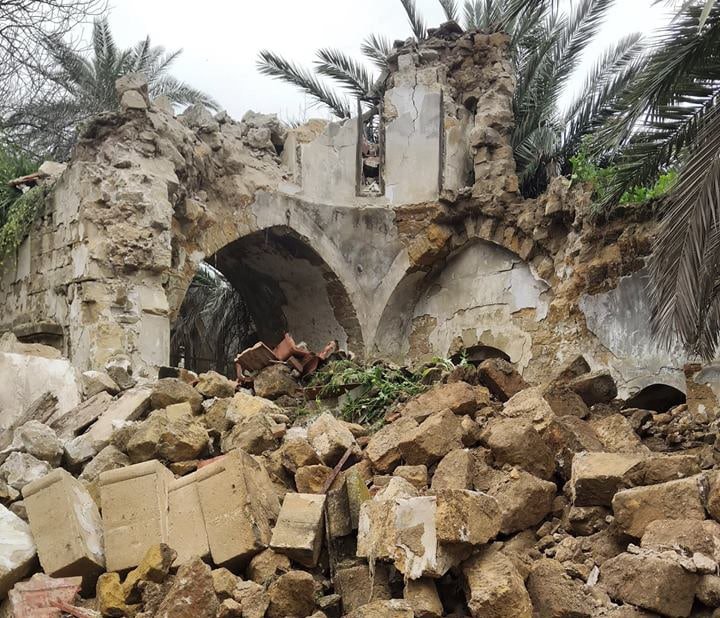
The first stroke of bad luck concerns location. Ayios Iacovos is situated in one of a few areas of the Green Line that happens to be under dispute between the United Nations and the Turkish army, according to the explanation offered by an Unficyp source to the Sunday Mail.
“It is a disputed area. It should be controlled by us but the Turkish army says it is under their control so in reality the latter is happening and we have no access to it,” says the source.
This in turn makes any project to save the building very difficult to implement. The first bicommunal initiative that attempted to do so was the Nicosia Master Plan which in the early 2000s raised the possibility of initiating works that would reinforce the church’s structure.
“The issue is complicated — to start with they could not even access the church,” a Turkish Cypriot administration official recalls. Because the Turkish Cypriot security forces help demarcate the line in old Nicosia, it was they who subsequently allowed Turkish Cypriot members of the Master Plan to enter the church to prepare a detailed report on what to do. Reportedly, they were willing to agree to work being done on the church provided it was done by a Turkish Cypriot contractor. Taking up the story again, the official tells the Mail: “The problem is that our side didn’t have money and we knew that we would not get money from the European Union unless the south agreed to it and because it is a disputed area we just knew it would not happen so we didn’t even try.”
Fast forward to 2014, when, after hearing numerous reports about the further deterioration of Ayios Iacovos, the issue was taken on by the RTCYPP.
“Since 2014, the five main religious leaders of Cyprus have been jointly advocating for the protection, reinforcement and eventual restoration of the church, working closely and quietly within the framework of the RTCYPP with Unficyp and the political leaders of Cyprus with the full support of the Embassy of Sweden,” the RTCYPP stated in answer to the Sunday Mail’s inquiry.
“When in 2017 the political leaders assigned the TCCH as the lead agent with the promise that the churches would be urgently reinforced, Archbishop Chrysostomos II gave his consent. Since then the religious leaders continue their united witness and joint advocacy to save the two historic monuments.”
But behind the scenes, at least some of the RTCYPP members are more vocal in expressing how disappointed and angry they were to hear that the church had what collapsed.
“We raised the issue continuously at various levels and very often we could not get any answers. We are very sad about this situation. We feared what could happen and it did. For four years we struggled to save this church and we could have averted the collapse …How come that we had so many people working on it and we didn’t succeed? I think it is a matter of political will,” a high-level official of the Archbishopric of the Greek Orthodox Church of Church opined while making it emphatically clear that he was expressing the official position of the Church.
The official made clear how from the outset the RTCYPP strove to save the church and noted that the Archbishopric was even ready to pick up the tab. But this initiative could go no further because once again, access to Ayios Iacovos proved to be the stumbling block. Later the Orthodox Church and the RTCYPP in its entirety was happy to support the TCCH approach that envisaged restoration work carried out under UNDP with EU funding until “we learnt about the mines issue and again there was no progress whatsoever.”
The so-called “mine issue” relates to UNDP’s standard operational requirement that the agency cannot support work in any area that has not been officially designated as mine-clear. Catch 22 once more since, not having access to it, Unficyp could not carry out a mine clearance procedure and declare Ayios Iacovos church mine-free.
According to the Archbishopric official, the Turkish Cypriot side was asked and subsequently promised to issue such a certificate that such a procedure had been followed, but, alas, this never happened.
Switch to the Turkish Cypriot administration official, who shakes his head when asked about the subject.
“Mines? Well, unofficially, there are no mines there and we know it but when it comes to issuing an official verification document that is a different matter entirely.” One more spin of the dizzying vicious circle. “From the Unficyp point of view, demining should be done by them. However, from the Turkish Cypriot Security Force’s angle, that cannot be allowed… so either the Turkish army is responsible for the delay or Unficyp cannot accept their word for it… Meanwhile the church is collapsing,” the bemused Turkish Cypriot official explains.
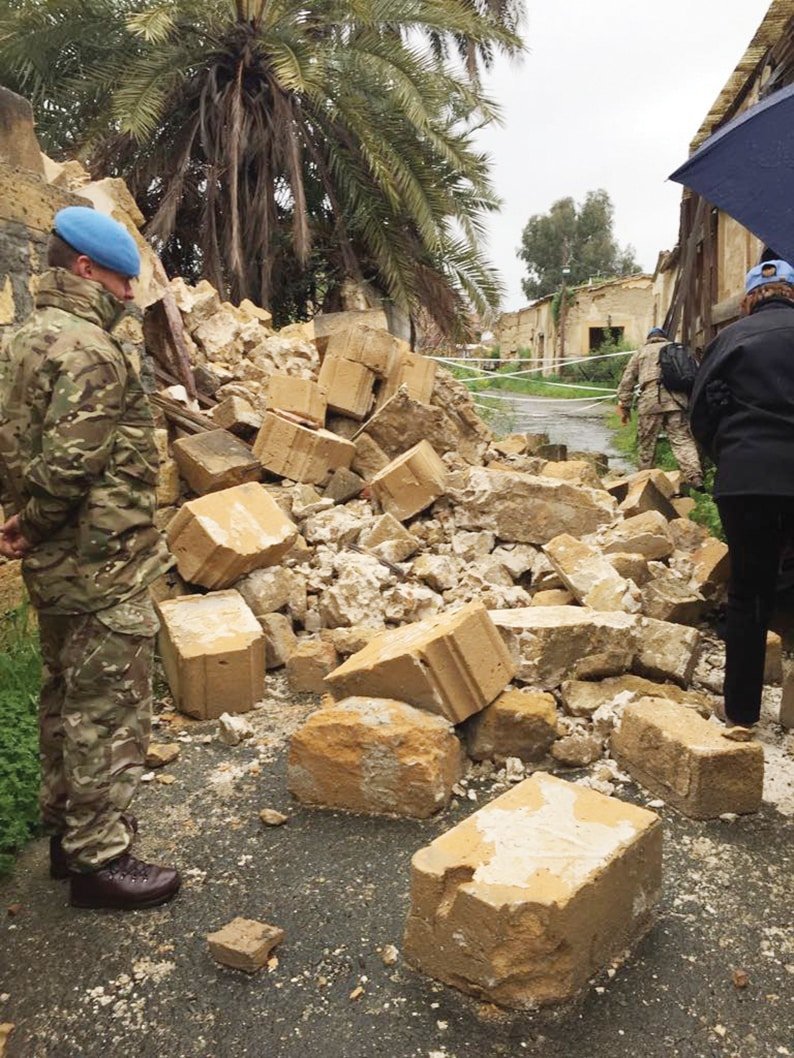
Fast forward again to the current situation. Part of the Ayios Iacovos church lies strewn in pieces in the middle of the main Unficyp buffer zone Unficyp patrol track.
The official plan (well the latest plan) is for Nicosia Master Plan (NMP) teams from both sides, with support from the TCCH and UNDP, to gather up the fallen stones and debris and remove them to a plot of land that has been prepared to the east of the church in the Unficyp-controlled area of the Green Line. However, behind the scenes (wouldn’t you know it), discussions are still ongoing as to what is going to happen next.
To start with, there’s the as yet unresolved mine issue” which begs the question whether anybody, anybody, can be permitted officially to do anything in this area. Making this even more complicated is the knowledge that mines, if they do exist in the area, have a tendency to shift positions when rains are relentless and torrential. (Of course, it goes without saying that they are not the only objects associated with this dilemma to be prone to shifting positions.
Meanwhile, the Church of Cyprus as the rightful owner of the site, and therefore must issue its written consent to any action being undertaken in the area, has some questions of its own.
“Our worry is not only that the stones must be relocated in a scientific manner. These are not just any stones. This is a 14th century church we are talking about. They have to be classified, numbered and preserved correctly so they can be used for rebuilding of the church,” says the Archbishopric official.
“However, our much bigger worry is what’s next? We as the Church of Cyprus are asking that this transfer of the stones must not be just a singular action but part of a road map that will spell out all the necessary steps for the restoration of the monument. Also, we want to know what will happen to the other church Ayios Georgios. We know it can collapse any time now. We need to know what is being done to avert this?”
According to Takis Hadjidemetriou, the TCCH Greek Cypriot head, the Committee asked both leaders to discuss the subject during their first meeting on Tuesday.
“All these issues are beyond the TCCH mandate. Usually the Committee is able to follow our internal procedures and what we decide is realised but this particular project is beyond our capabilities. That is why we are asking the leaders to solve it.”
Back to square one?
A place of worship steeped in history
By Agnieszka Rakoczy
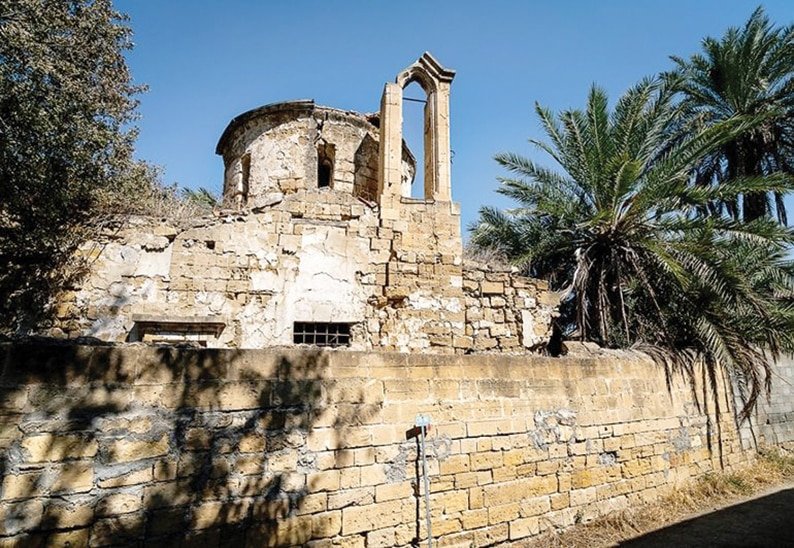
AYIOS Iacovos Church, also known as Ayios Iacovos de Persis, St Jacques de la Commersarie, St Giacomo and St James, is located in the eponymous side street off Ermou Street, in Nicosia’s buffer zone.
It was probably built in the 13th or 14th century and once was surrounded by other buildings that were used for monastic purposes.
It seems that originally the church was Latin and bore the name “La Chapelle de Saint Jacques de la Commersarie de Sire Simon de Montolif”.
De Montolif was the butler of the Kingdom of Jerusalem and the Admiral of Cyprus under King Hugh IV who lived at the beginning of the 14th century. The chapel seemed to be his private property or maybe even was built by him. In some records it is said it was just next to his house. The word “commersarie” in the chapel’s name derived from its location, close to one of the octroi houses (comerchio) of the town.
The church is mentioned in 1469 when an Arnat Mode sold it for 150 bezants. Unfortunately, we don’t know who bought it. However, in a document, dated 1544, discovered in the Archives of Venice by Dr Nasa Patapiou, there is a note that in 1486 it was the seat of Archbishop of the Maronites.
After the conquest of the island by the Ottomans, in 1570 the chapel was taken over by the Turks and given to a wealthy jannisary who used it as a stable. Then, according to Tsirplanlis’ documents, in 1627-28 a French missionary named Pacifique de Provins, who most likely was a Capuchin working for Latin Bishop of Paphos Pietro Vespa, purchased it (calling it San Giacomo) for 70 piastres.
By 1638, the church was given by Vespa to the Capuchins monks from the province of Turenne in France and functioning as the Latin cathedral of Nicosia because of its location in the area where many members of this community lived.
Leader of the local Observant friars Giovanni Battista da Todi wrote in 1647 that despite its important status the church was rather modest and had only one priest, but also a hospice attached to it.
By 1661 da Todi succeeded Vespa as Bishop of Paphos and in one of his letters mentions San Giacomo again, saying that although the church was built in stone it was in danger of collapsing because of its age. Da Todi obtains a permission to repair it from the Turks and the church is renovated by 1665, acquiring more 17th century appearance.
Da Todi also mentions that in the church there was a very famous wall painting of St James (Ayios Iacovos de Persis – a black military saint) venerated by all communities who brought sick children to the image in search of cure. A lot of miracles were attributed to the Saint, especially cures of the ears.
This is confirmed in 1788 by Archimadrite Kyprianos who also refers to the church of St James the Persian belonging to the Capuchins fathers in Nicosia.
However, soon after, by the end of the 18th century, the church and its buildings came into the possession of the Dragoman of Cyprus Hadjigeorgakis Kornesios who repaired it in 1797 and later used it as chapel for his family. Kornesios also donated some new icons to the church, of Christ and the Virgin Mary, which dated 1797. There were also older icons in the iconostas such as of St Mark the Evangelist dated 1649.
Sometime in the 19th century Kornesios’ grandson Georgos Tzelepi gifted the church and other buildings to the Greek community of Nicosia to be used as an orphanage and foundlings institution under the administration of the Archbishopric of Cyprus.
The church is mentioned in 1873 by Archduke Louis Salvador in his “Lefkosia the Capital of Cyprus”, by Rev J Hackett in “The History of the Orthodox Church of Cyprus” in 1901, and in “A Description of the Historic Monuments of Cyprus” by George Jeffery in 1918.
It underwent a restoration in 1899 when most likely it acquired the current look, and after Dianelleio Orphanage was built it was used again as a small monastery.
In 1964 the Turks set fire to the church and as a result the iconostasis and all the icons on it were destroyed. Since then the church has been in the buffer zone. Some time before 1974, Unficyp cleaned its interior and used it once more as a worship place but after 1974, it was abandoned once again.
The Church of Saint George of Adalia or Satalia stands in the buffer zone in the parish of Chrysaliniotissa.
Rev J Hackett wrote in 1901 that the church was supposed to be situated opposite the house of Sir Thomas Parch, steward of the royal court in 1382.
Satalia, a city in Karamania, was captured by Peter I of Cyprus in 1361 but lost again to the Sultan of Alanya by Peter II in 1373. Its garrison withdrew to Kyrenia carrying among other items a very celebrated picture of the Virgin, and the chapel that later became the church of St George, reputed to be erected in memory of the one in Satalia, received this precious icon.
George Jeffrey wrote in 1918 that although the church belonged to 18th century it was definitely built on the site of a medieval structure and has some surviving details from this period, including a panelled side of a 15th century sarcophagus with three large coats of arms on it, including this of the rich Syrian family of Gourri (Urry or Hooury) who used to be owners of the village under the same name. We know that this panel is still there.
The church was burnt by Turkish troops in 1974 but local residents managed to save many of its icons that are now located in the Byzantine Museum of the Archbishop Makarios III Foundation in Nicosia and the Monastery of Machairas.
(Information provided by Dr Rita Severis, the Archbishopric and the Association of Maronite Cypriots)

