
An interactive bell – that anybody is free to ring – has been installed at the Ledra Palace in Nicosia. AGNIESZKA RAKOCZY meets its creator, a man in tune with the nature around him who thinks art should serve a social purpose
Talking to Marcus Vergette once he gets into full conversational flow is like diving into a stream of consciousness. His is a story that sweeps you along in a turbulent wash of words. This vibrant artist, a painter/sculptor turned farmer who, after being beset by a devastating outbreak of foot-and-mouth disease, stays faithful to his smallholding in Devon, drawing inspiration and consolation from the life, and death, cycle of a farming existence while finding creative affirmation and solace in bell making.
What brought about the artistic switch from sculpture to becoming a creator and caster of bells?
When the foot and mouth outbreak of 2001 that confined him to his farm for almost six months and resulted in the culling of his livestock was officially declared over, Vergette accompanied the parish bell-ringer to the church tower and witnessed him peal out the good news that the community’s ordeal was finally at an end.
Vergette had never thought much about bells before. But on the day quarantine ended, he sensed them calling out.
On a beautiful sunny day when he was free at last to walk the hillside he was able to greet the neighbours he hadn’t set eyes on during his confinement. Everyone looked haggered and worn out from the dreadful experience.
Following the bell-ringer into the church tower in that west Devon village proved to be an artistic epiphany as he came alongside the three bells, two from the 14th and one from the 15th century.
“I took in these huge bronze bells, sculptures and communication devices, and it suddenly dawned on me what fantastic art objects they are. Even better, an art object that wasn’t about me,” he recalls.
As though the village had read his thoughts, the devastated farmers turned to Vergette and asked him to put his artistic vision to work and commemorate what he terms “the needless” slaughter and hardship they had all endured.
“Since I am not a religious person, I thought a bell that could be rung by anybody would be nice. Everyone thought it was a lovely idea. But then it transpired that it was illegal to make a ‘democratic bell’ because the control of the peal of a bell is an expression of power. So we had to go through a legal process to prove that it wasn’t a matter of law but a fault of the history of power [Church and State] that had denied the idea of a democratic bell. For me, this was more or less the final piece of a puzzle – that this object contained that much power, and that it was a communication device.”
Trained at St Martins in London, Vergette, like many artists, pursued corporate art commissions and exhibitions at the outset of his career. In the 1990s he visited many of the countries of the former Soviet Union and was impressed with how much they knew about art in the West when the West seemed indifferent or knew so little about the state of their arts and the significant social impact of what they had achieved with so little. These visits had a profound effect on his creative vision. He found himself becoming increasingly disillusioned with the demands of commercial patrons and more and more drawn to creative work within a social context.
All his projects are locally-inspired, he says, and he is grateful because by his own admission he never wants to do corporate art again.
“Somebody thinks it will be good to put something up somewhere. I just wait for people to contact me. I don’t do any promotions because that would be me directing a project and that runs contrary to my idea of art. Thankfully, people seem to hear of me and the phone keeps on ringing so I continue to have work.”
One of his current projects is a series of bells to mark high tide at different points along the British coast. Five are already in place and the aim is to have nine by next year, and 12 in total, ringing out to mark high tide at their different locations.
Reverting to the theme of local inspiration, Vergette notes that it was a chance encounter with someone from Cyprus when he was speaking about his time and tide project that led to his being approached by the Artos Foundation. Last year they got in touch with him and suggested he consider designing a bell for placement in Nicosia. Now realised, that installation, an interactive bell, has taken its place outside the Home for Cooperation at the Ledra Palace crossing.
The bell has “three different voices” and is made of oak from Vergette’s farm in Devon. “The thing was to make it accessible and easy to ring so that a child or an adult can ring it.” Thinking about the space (he calls it “rather hard and unloved”) and taking into account the “very complicated situation out here”, he philosophically points out that the selected bell site is set back from the road and partially hidden by a low fence. He has sought to give voice to the people who use the space regularly, while realising that most of the voices who speak about division “never come here”.
This is, he makes clear, a secular bell. It sounds different and has a different shape. “I thought of this acoustic war going on out here [church bells and the mosques’ calls for prayers] and concluded that there was nothing I could do about it, not being religious. All I could do is offer some alternative.”
His hope is that people will start to use his bell and share about it on social media and that they will see it as “friendly, a soft bell, not declamatory, a quiet bell.”
He pauses as a nearby church bell rings out and says: “Listen to this bell here – the structure is harmonically constructed in such a way that there is a dominant sound and this is a concept underlying the construction of church bells because it is about dominance of the church and the fact that you cannot talk directly to god. Instead you must come to the church and it is the church that informs you – that is the basis of its power.”
He is at pains to point out how his bells’ tones are harmonically related so that there is no dominant tone. This means that theoretically and physically it has no authority. It is owned by no one. “It has no specific authority and makes no statement other than everybody and anybody can ring and nobody owns it.”
Vergette admits that he himself has a problem with authority and says he knows exactly the moment in his life when it started: at a school when he was six and his teacher would punish him for asking too many questions. “And I thought that is it – this is power – they don’t answer your questions. I stopped going to school. I became a very bad truant, another reason why I became an artist.”
He talks about mobility and the fact that lots of his bells are on wheels because situations change just as the world changes. He does not believe that sculpture has to stay in one place all the time. A sculpture of an historic figure may no longer be relevant or may have greater relevance if moved to another site. We should not become fixated on art having to have its place, he admonishes.
In his own life, he has moved around a bit. He was born in the American mid-west but it was art school in London that helped make him who he is. “Before that I didn’t really find a place.” He is British. His parents too. They moved back and forth many times but he didn’t feel aligned with any one place.
While studying at St Martin’s he found himself painting on boards, often cutting the boards up. It made him realise how important working with his hands was to him. “I think I must have been one of those horrible little boys always banging away with a with a hammer.”
Our brains, he suggests, are not only in our heads. Have a problem, go for a walk, quite often you’ll come up with a solution. Ergo, part of our brain must be in our feet. Quickly he jumps back to the subject of hands. “I like their cleverness, the way they connect and can manipulate. You can look at something but you cannot really manipulate it with your eyes. Hands are the real way you meet the world whether cooking, loving, creating…”
Having lived in London for a decade, the need for studio space drove Vergette and his wife Sally to the countryside in the late 80s. City birds, neither was convinced that the country life was for them. Yet, having spotted a likely property, they blithely bought it that same day. It was a life-changing decision, one he never regretted. “I saw a barn and a house I reckoned I could fix up and some land. I never thought about it. All I could see was this space. Had we visited a different farm on this day I might still be in London. Who knows. But it has become a very important part of my life to observe nature, to watch things grow and die.”
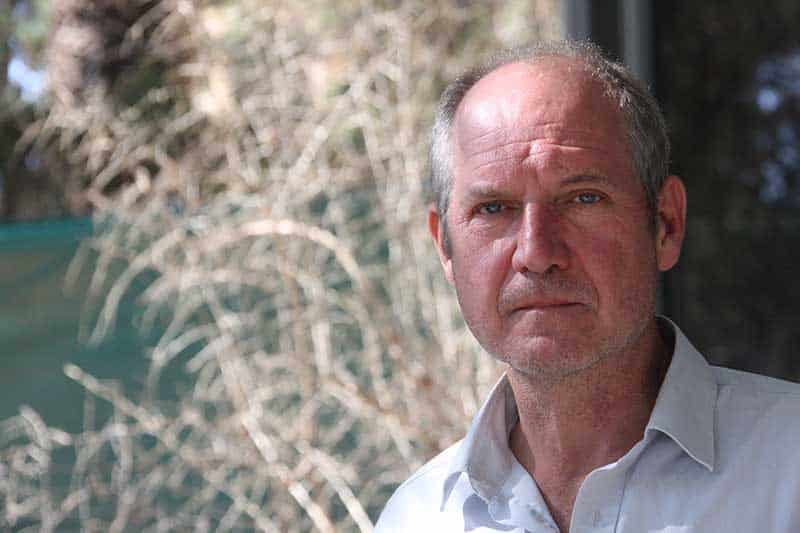 He is firmly rooted in his West Devon farm, he says. “Farming has been a very necessary part of my life. My wife does the thinking part and I just do the digging and carrying and driving the tractor and that kind of stuff. We have 40 sheep and 15 cows. Yes, it is work but it is nice work. I have a vegetable garden so I have a place to live and all my food which allows me to be more selective with all the things I make. I only make the things I want to make but if there is something in the situation that I don’t like I know I have always got my food.”
The dividing line between Marcus’ life and his little piece of land is almost indistinguishable, he feels. “I don’t know who is running the show. Is it the tree that gives me the oxygen? One way or another I don’t know.” This realisation has had a huge influence on his approach to life and art.
So yes, life in the countryside changed him. “Simply put, if each of us grows a lovely garden the whole world would be a lovely garden. That is my philosophy. So my politics is just to help the gardens to grow – not to tell people what to plant. I think politics gets in the way of people.” He believes we are all part of the planet and that it is our vanity that is destroying it. “How can people say this is how it is when they cannot tell you what butterfly flies at this time of the year or name a specific tree, detail its life cycle and the small creatures that live and depend on it?”
We overestimate our philosophical capabilities so he says let those who are smarter than him wrestle with the philosophical issues. “I just want to open the world of experience – observe, listen and understand before we start making pronouncements about how things are. Try to understand rather than make judgements.
There is so much to learn before we can arrive at meaning.”
‘We sound together Interactive installation in public space’
By bell designer Marcus Vergette and trans-disciplinary human Achilleas Kentonis is located at the Ledra Palace crossing, opposite of the Home 4 Cooperation.
The installation is part of the Does Europe Exist Project developed by Nicosia’s Artos Foundation. The three other components of the project are: a week-long exhibition with the participation of both international and Cypriot artists that will start on November 15 at 8pm, a symposium/ pop-up think tank taking place on November 15 between 6pm and 8pm, and a digital publication documenting all actions that will be published in December 2017. Artos Foundation is based in 64 Agion Omologiton Avenue, Agion Omologiton, in Nicosia. Tel:22 445455.

