
Kia has entered Europe’s fastest-growing market sector, B-segment SUVs, and expects to sell 70,000 versions of its new Stonic model in Europe in 2018, rising steadily to 100,000 a year.
The B-SUV market in Europe is expected to double to more than two million vehicles a year by 2020.
Stonic is based on the latest Rio supermini and is powered by high-efficiency, high-technology petrol and diesel powertrains from Rio and the cee’d family. It was designed in Europe at the company’s Frankfurt studios, with input from the main design centre at Namyang in Korea.
Originally intended as a car solely for Europe, it will now also be sold in Korea, such was the reception it got when shown there.
In Cyprus there will be a three-model line-up with a choice of two petrol engines and one diesel powered variant.
Stonic is Kia’s first small SUV, slightly longer than Rio, at 4,140mm. It is also 70mm taller and rides 42mm higher from the ground to give it a clear SUV stance. While the two cars share some mechanical components, Stonic has a bespoke body and interior. All models are front-wheel drive as the take-up for all-wheel drive in this sector of the market is only eight per cent.
Buyers are moving into B-SUVs from superminis, small MPVs and three-door compact hatchbacks.
A horizontal theme in the cabin emphasises width and space while separating the upper information and lower control areas. The number of buttons and switches has been kept to a minimum to give a neater look and greater functionality. The First Edition version offers USB ports front and rear so that mobile devices can be charged from any seat.
Electronic Stability Control (ESC) and Vehicle Stability Management (VSM) are standard. VSM is linked to Torque Vectoring, Straight Line Stability and Cornering Brake Control to help the driver maintain control in bad weather or on poorly surfaced roads. All versions also have Hill-start Assist to prevent the car from rolling backwards when setting off on steep inclines.
Autonomous Emergency Braking and Lane Departure Warning are standard in the First Edition spec and optional on grade two as part of an Advanced Driving Assistance Pack (ADAP). The Lane Departure Warning System is linked to Driver Attention Warning, which can alert a drowsy or distracted driver that it is time to take a break, and High Beam Assist, which automatically switches the car between dipped and full beam according to the traffic around it and the local street lighting.
The First Edition also has Blind Spot Detection with Rear Cross Traffic Alert, to prevent the car from being driven into the path of a vehicle approaching from an angle out of the driver’s eye-line.
There is a 7.0-inch display with a DAB radio and MP3 compatibility in grade two, and in the First Edition this is upgraded to a 7.0-inch touchscreen navigation and infotainment system featuring Kia Connected Services with TomTom™. Android Auto™ and Apple CarPlay™ smartphone integration are standard across the range.
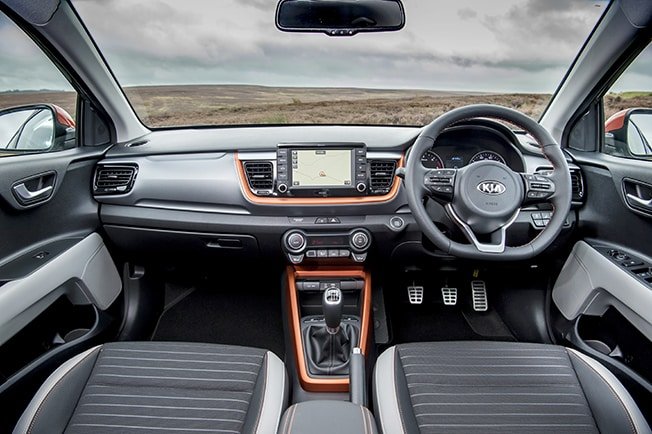
All models have 17-inch alloy wheels, air conditioning, all-round electric windows with an automatic function on the driver’s side, roof rails, rear parking sensors, remote locking, electrically adjustable heated door mirrors, a 3.5-inch supervision cluster, Bluetooth with music streaming, automatic headlight control, bi-function projection headlamps and cornering lights and LED daytime running lights.
There are body-coloured bumpers, door mirror casings and door handles, steering wheel-mounted audio controls, 60:40 split rear seats and a six-speaker audio system.
The First Edition adds a smart key entry system and engine start/stop button, stainless steel pedals, black cloth and grey faux leather upholstery with colour accents, automatic air conditioning, LED rear lights, privacy glass on the rear side windows and tailgate, heated front seats and D-shaped steering wheel, chrome window trim and interior door handles and a dual-height luggage floor.
The 1.0-litre T-GDi (Turbocharged Gasoline Direct-injection) unit delivers 118bhp. It lines up alongside a 1.4-litre multi-point injection (MPi) naturally aspirated 98bhp petrol engine and the 108bhp 1.6-litre CRDi turbodiesel from the cee’d range.
ISG, Kia’s engine stop/start system to ensure no fuel is wasted and no emissions are pumped into the air when the car is stationary, is standard. All versions are paired with a six-speed manual transmission and are front-wheel drive.
The T-GDi engine develops 171Nm of torque across a wide rev band starting at 1,500rpm, allowing it to accelerate from standstill to 60mph in less than 10 seconds, yet it is also capable of up to 56.5mpg, while CO2 emissions of 115g/km are not much more than those of a diesel.
The fuel economy champion of the Stonic range is the diesel, which has a combined economy figure of 67.3mpg with CO2 emissions of 109g/km. Yet with 260Nm of torque stretching from 1,500 to 2,750rpm it delivers “impressive in-gear acceleration” and takes 10.9 seconds from 0 to 60mph.
Meanwhile the 1.4-litre petrol engine, available exclusively in the grade 2 model, has economy and emissions figures of 51.4mpg and 125g/km. Despite its relatively small cubic capacity it delivers 133Nm of torque.
Stonic relies on a similar suspension system to Rio, with independent MacPherson struts at the front and a torsion beam axle at the rear, but there has been extensive retuning to take into account the SUV’s higher ground clearance and centre of gravity.
Kia says the Stonic has “the best warranty in the business” – a seven-year/100,000-mile declaration of faith in the reliability and quality of the car, covering all labour and parts except those subject to normal wear and tear, and the warranty is transferable if the car is sold before the time/mileage limit expires.
The Stonic should be in local showrooms within a month, although prices aren’t yet available.

