
THEO PANAYIDES meets a Krav Maga expert who has been on the mat since the age of six and explains why it is important to be able to move from Mr Nice Guy to Mr Not So Nice Guy
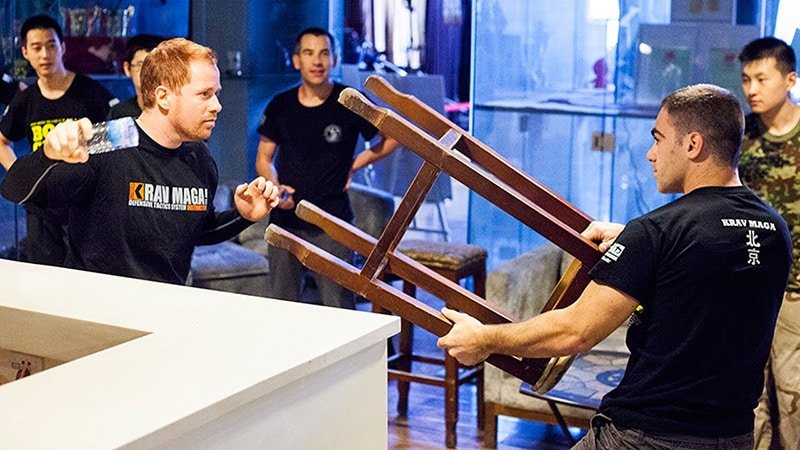
Everyone’s wearing black, I’m wearing white. I get a few puzzled looks, which is slightly unnerving since the people giving me those looks – mostly young men and boys (plus a few women) dressed in near-identical black T-shirts with the logo of KMG, Krav Maga Global – are also twisting each other’s arms and placing each other in headlocks. “We will not test with the knife today,” says the square-faced, soft-spoken man in the middle, demonstrating how to fend off an attack with a bottle instead. His students try out the moves in teams of two, using plastic water-bottles as props; there’s a fair bit of laughter and horsing around. One youngster successfully subdues his ‘attacker’ – then, in a classic bit of lad tomfoolery, aims the bottle up his bent-over friend’s backside.
It’s not serious, almost a social occasion: a ‘bar fight seminar’ taking place in an actual bar, Potopoleio in Nicosia. Nonetheless, Krav Maga is the real thing, an Israeli fighting system teaching people how to defend themselves (“It’s not a sport… It’s survival”) – and Albert Kagalski, the soft-spoken man in the middle, is the real thing too, a Class 3 Expert who’s been doing Krav Maga since the age of 12. Albert is a kind of global ambassador, travelling widely with KMG, yet he doesn’t come across as a natural showman. He doesn’t joke with the students, simply stands there projecting quiet authority, showing how it’s done like a mechanic demonstrating the correct way to work a lathe. If your shirt is grabbed from behind, turn around quickly, glide your head under the guy’s arm, grip his forearm with your right hand then, using the right arm for leverage, push down on his face with your left; “OK, let’s go!” concludes Albert, stepping back to watch his charges at work.
I sit down with him later, at a corner table with his back to the wall (which, coincidentally, is where a Krav Maga expert would sit in a bar, so as to have a better vantage point). He’s 37, with unblinking blue eyes and a wry sense of humour; he doesn’t crack a smile when being photographed, but a rare gap-toothed smile does occasionally appear as we talk. His English is imperfect, Hebrew and Russian being his main languages; he was born in what’s now Moldova, spent his first five years in deepest Siberia (his dad was a mining engineer), then back to Moldova, then to Israel at age 10 with his parents and sister, part of the big Jewish exodus that accompanied the collapse of the USSR.
“We are teaching people to be aggressive when it’s needed,” he explains in his calm, soft-spoken way, indicating the seminar. Yes, I point out, but isn’t aggression a state of mind? You can teach people fighting moves, but how will they react if a real brawl breaks out? “We have techniques for that,” he replies equably, and tells me about “the switch from Mr Nice Guy to Mr Not-Nice Guy” – the switch that unlocks one’s inner “predator” and exists in all of us, however mild-mannered. Not that he’s trying to create killing machines, he goes on; violence tends to provoke a fight-or-flight instinct, and in fact both ‘F’s are acceptable. “If you can flee, you flee, if you need to fight, fight – just don’t do the third ‘F’, which is freeze. Don’t freeze.” In a way, what he teaches is confidence, trying to avoid the sense of helplessness that may cause people to become sitting ducks (ie to freeze) in dangerous situations.
For him, this was never a problem. “My personality was aggressive from the beginning,” he admits. He wasn’t angry, even in his teens when he fought all the time – but the switch came very naturally, maybe because he’d been “on the mat” since early childhood (he started with judo at the age of six; nowadays he does wrestling, MMA and Brazilian jiu-jitsu as well as Krav Maga). His adolescence offered frequent opportunities for honing his skills. The Kagalskis settled in a “problematic” neighbourhood of Kfar Saba, just outside Tel Aviv, in the early 90s; they were never practising Jews, indeed Albert hadn’t even known he was Jewish till the age of seven – and of course he didn’t speak the language. The result was inevitable: “All the time it was engaging with the local population, the local kids. They didn’t understand us, we didn’t understand them, and it always was engaging.”
Engaging?
“Fighting. Fighting all the time. Almost every day.” He wasn’t angry, he repeats, “but I took very hard any – uh, not reasonable behaviour to my side from the local Israelis”. A challenge might be issued, an insult hurled, and suddenly fists were flying; it was juvenile gang warfare, Albert’s ‘gang’ being the local posse of recent Soviet immigrants – incidentally including a girl from Dushanbe in Tajikistan who many years later became his wife (they have two boys, eight and four years old). What did his parents think about all this? “They not have so much time for us. All the time working… So we actually was by ourselves.”
Did he win all those fights?
Mostly, he nods. “I get hit many times in my life, but I always finish the fight. At least when I’m standing on my legs.”
Has he ever been knocked unconscious?
“Me? No. Sometimes someone yes, but not me.”
So he’s knocked other people unconscious?
“Yes, many times.”
Back then, or recently?
“Back then. Today I’m not getting into this situation. I’ve fought a few times since my army service, on the street, but every time I’m – how I say – I’m trying to keep my opponent in one piece!” It’s an interesting point, in that Albert has the opposite problem to most people. Most of us worry about accessing that inner predator when trouble hits, but for him it’s all about controlling the switch – which he now does successfully, he assures me, though I still suspect his personal standards are a little looser than average.
“I will tell you a situation. One time, I was with my kid and my wife in the car. And some guy in front of me did some manoeuvre that was very, very – not smart, and I [only just] avoided a car accident. I stopped the car, I ran to him. For a moment, I think the control was lost” – Albert clenches a fist to denote uncontrollable rage – “but I know exactly what I want to do to him. I ran to his car, and punched his face through the window! Then, when I went to punch him a second time, I saw the guy saying ‘No, no, don’t hit me’.” His fist relaxes, to denote the switch flicking back: “I stopped the second punch, turned, and got back to my car and continued to drive.” He shakes his head at the memory: “It’s not easy to control these situations, but you’re learning all the time – don’t lose the mind. All the time, be cold-minded. And even if you lose it for a moment, recover it.”
“Wouldn’t it have been better not to punch the guy at all, though?” I ask, and Albert looks a little abashed. “But I guess you really wanted to punch him,” I add, trying to be sympathetic.
He nods, smiling ruefully: “I really wanted to punch this guy!”.
Not everyone will smile at that story. Some will say that violence is never acceptable, and will criticise Albert as a thug and a dangerous person. There may be something in that – but it’s also true that the road-rage story happened five years ago, and he hasn’t been involved in a fight since. He seems calm, not remotely aggressive, and insists that it’s now very hard to make him angry. What about with his wife and kids? It’s a well-known fact that kids make you crazy.
“Kids can make everyone crazy,” he agrees. “But in the family is different. It’s a different kind of crazy.” What happens when he and his wife want different things? Does he just back down, to keep the peace? “Yes, definitely! In the family life, I’m very calm, I don’t let myself get angry. Because, you know, it’s my wife, I love her, so she can do almost what she wants. And the kids too, with some limits” (though the kids are “really good guys,” he adds tenderly, and rarely make trouble). Speaking of women, I venture – going off on a bit of a tangent, but I’m curious about his reply – what do they want? It’s a well-known fact that alpha-male machismo isn’t very popular at the moment; our culture encourages men to be peaceful and sensitive. Does he think women secretly want an old-fashioned warrior – like, say, himself – behind the façade, however?
Albert looks puzzled, asking me to repeat the question. “My philosophy in life,” he replies at last, “is I’m always trying to find the middle. A man should be a man – but he needs to listen to his woman too.”
‘Being a man’ is a tricky proposition these days. You can see it in the youngsters in their black KMG T-shirts, trying out the Krav Maga moves as if cloaking themselves in a soothingly primeval idea of manliness. “A man should be a man,” says Albert Kagalski – implicitly meaning bossy, decisive, violent if necessary. There’s no doubt his aggressive personality has the potential to be thuggish and anti-social. He might even have made a good criminal – yet he didn’t go in that direction, doing his best to control the infamous ‘switch’, due above all to two factors. The first is the discipline of training, Krav Maga, and martial arts in general; the second is being a Jew, or more properly an Israeli.
Albert credits the army with having helped him feel at home in Israeli society, and opened his eyes to his Jewish identity (he did his service just before the third intifada, including stints in the Gaza Strip and southern Lebanon) – and Krav Maga, developed for the IDF and Mossad, is very much aligned with a close-knit, suspicious country forever looking over its shoulder. Krav Maga experts, as already mentioned, tend to sit with their backs to the wall in a strange bar, and Albert also recommends holding your phone at chest height when you check it (the better to spot attackers with your peripheral vision) rather than looking down. What he calls “the situation with the Arabs” is a constant factor in Israeli life, and has even been incorporated into Krav Maga training which now includes terrorist scenarios. (Isn’t that rather unlikely to happen? “In Israel? No, it’s very common! Very common!”) Why not trust other people, though? Why assume that they’re out to get you? It’s about “general awareness,” replies Albert patiently. “Be ready for anything… And try to be nice to people,” he adds, as a kind of afterthought.
Clearly, it makes a difference; just as teenage alienation led to near-daily fights, feeling like a part of society – especially a society that considers itself to be under threat – naturally leads one to be self-controlled and responsible. But the most important factor in Albert’s life is surely Krav Maga and physical training in general, acting as a lifelong channel for potentially toxic aggression. What was his plan, I wonder, back in those stormy days of adolescence? What did he want out of life? “No plan,” he shrugs. “The only thing I always do, I train. I do some sport. This was my guideline in my life: doesn’t matter what happens, I continue to train… The first [thing] for me always was to go to the training place, to the gym – and that saved me from many, many troubles in my life.”
In the end, his message is clear: when things are going badly (and even when they’re not), get some exercise. “Training, sport. Doing something,” he enthuses. “Walk, run, jump – do something with your body! For me, it’s very helpful, and I’m sure for other people too. I really believe in it. Moving, it’s life. Not moving, is death.” His life-plan, it must be said, remains rather hazy: Krav Maga is his passion, of course – but he’s tried other jobs over the years, started a rental-car business (it didn’t last), and has just completed the first year of a university course in Nutrition. It may well be that Albert Kagalski hasn’t really found himself yet – but I ask if he ever gets depressed, and he shakes his head firmly. We all tend to live inside our minds – but he regulates his mind through his body, the physical side that’s always expressed him most eloquently. Fighting keeps him fit, and may keep him sane. “Everything is fighting,” he affirms, and looks at me shrewdly.

