
THEO PANAYIDES meets a leukaemia survivor who now wants to spread the word that cancer is not always a death sentence and can be a life changer in more ways than one
Most of the time, you interview a person to find out who they are and instead end up talking about what they’ve done. Exactly the opposite happens with Chrysanthi Demosthenous, sitting in the coffee shop of a Limassol hotel with her mum Vasiliki in discreet attendance. I assumed we’d talk mostly about what she’s done, or more accurately what she’s endured – the Acute Myeloid Leukaemia (AML) that nearly killed her six years ago – but in fact she also talks a lot about who she is, what kind of person, what kind of character.
“I’m a strong personality, but I’m sensitive too,” she tells me. Or, a little later: “The truth is that, without meaning to, I always manage to be out of step with the crowd”. Or, later still: “I feel like my character tends to wear me out spiritually, because I’m always seeking change, improvement, something different, not just doing the conventional thing. With anything.”
It’s only natural, of course: Chrysanthi is 22, an age when the urge to self-exploration is at its strongest, an age when you try to determine – as you stand on the brink of adulthood – just what kind of person you really are. Every 22-year-old looks inwards, even the least narcissistic – but with her there’s something else as well, because she survived. She fell ill with a terrible disease, and survived. “This story never really ends, there’s never a full stop,” she cautions; she’s seen people suffer a relapse after years of apparent good health. Still, here we are on the first day of 2017, a year she must’ve thought she’d never see during the darkest days of her illness – and the question gnaws at her, as it would at anyone: Was she just lucky? Why did she survive, when others don’t? Was it just the will of the cosmos – or something to do with her, what kind of person she is, what kind of character?
“I can’t really remember myself before the diagnosis,” she admits, and laughs. She’s polite, articulate, talkative, soft-spoken. She has clear brown eyes, and wears black nail polish. She laughs often, but twice comes close to tears as she recalls her ordeal – which began when she was 15, almost 16, and “a very correct person” as she puts it, trying to describe that old teenage self. She was studious, organised, a good kid in general. Chrysanthi is the third of four children (she has two sisters and an older brother), and grins when I note that children in large families invariably end up settling into a particular role, often defining themselves against their siblings. What was her own ‘role’ within the family? “I was the quiet one, the good one. The child who – you’re laughing!” she exclaims at her mum, who is indeed stifling a chuckle – “the child who always solved everyone else’s problems, the child who’d always back down so as to keep the family together”. Her life was uneventful. “My daily routine was school, private lessons, hanging out with friends now and then. The usual daily life of a 15-year-old, nothing very ‘wow’.”
Looking back, were there any signs of what was to come?
Not as such, she replies (“It was very sudden, very difficult,” confirms Vasiliki), but the fact of being so organised did make her symptoms stand out more, the main early symptom being fatigue. She’d come home from school and just fall asleep through sheer exhaustion, ignoring her various obligations – which is when she knew something was wrong, because Chrysanthi wasn’t (and isn’t) the kind of person who’d neglect her schedule like that. Yet she also spent a month in denial, even when her legs turned black with unexplained bruises (easy bruising is another symptom of AML). “To tell the truth, I kind of guessed what it might be,” she admits; her plan at the time was to study Medicine, and she recognised the symptoms from some reading she’d done – yet she still tried to rationalise the bruises away, only going to a doctor at her parents’ insistence. She wasn’t ready to face something like that.
Because it would spoil her schedule? I suggest half-jokingly.
She smiles: “The truth is, I’m a perfectionist. And it’s exhausting!”
The doctors confirmed what she’d already suspected; “When they said I had to go to Nicosia for more tests, I was certain”. Her Limassol doctor made it even clearer, begging her to go that very night “or you might not wake up tomorrow”. According to Wikipedia, “AML is cured in 35-40 per cent of people under 60 years old and 5-15 per cent over 60 years old” – the difference being due to the fact that treatment involves intensive chemotherapy, too intensive for most elderly bodies. Admittedly, Chrysanthi’s particular sub-type (M3) has a higher survival rate, but she still stayed in hospital for almost a year – albeit on and off, after the first six months – and kept taking pills for three and a half years after the treatment was over. At one point she was taking 45 different medications, which of course saved her life (“I feel lucky to have been diagnosed in this century, and not the last one,” she notes dryly) but also had side effects. She lost her hair. She developed photophobia, an intense sensitivity to light. Everything around her flashed, and was dizzyingly bright. She spent a month in a darkened room with the curtains drawn, “with towels over my eyes, because the light was too bright”.
That was in the first month of her hospital stay. Was that the worst time? “That’s what I thought in the first month. Then, in the second month, other things arrived which made me long for the first month.” The pain grew more excruciating, pain in her bones that left her unable to walk without support. “Then there was the dizziness, the nausea, there was not being able to open my eyes for a month, there was not being able to find a vein to inject me with medicine”. Her veins had grown brittle, and easily broken; the nurses often had to puncture her 10 times just to get a blood sample (she still has a scar above her breast from the so-called Hickman line, a catheter inserted in her body to administer chemotherapy). Her mother takes over, telling of a day when Chrysanthi had such terrible spasms she couldn’t even take a sip of water. “I thought we were going to lose her,” recalls Vasiliki. “But she said: ‘Don’t worry Mum, we’ll beat this thing’.”
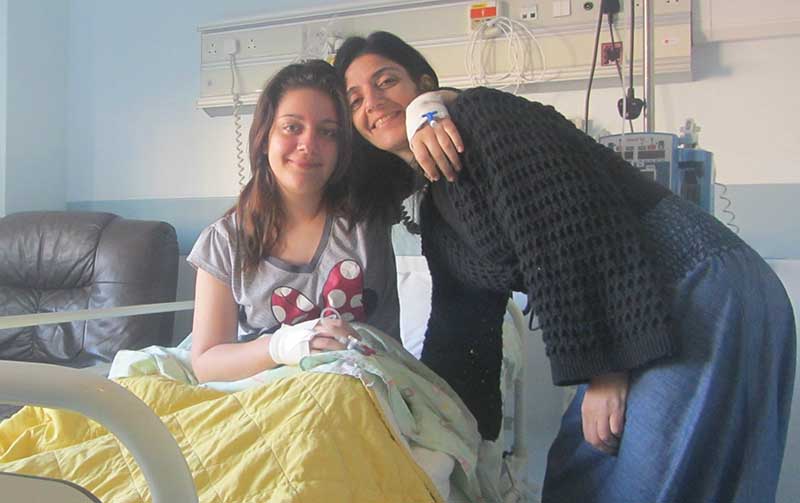 This is where character comes into it, making you wonder where random good fortune ends and personal factors begin. To be sure, Chrysanthi had a strong support system. Her dad had lost his job a few weeks before she fell ill, a double blow that nonetheless had a silver lining in that he was able to sit with her and encourage her. Many of her friends visited regularly and she made an effort to talk to them, “so they’d know that ‘I spoke with her today, she was okay’. And in fact I had friends who – they only told me this later – wanted to talk [every day] because they wanted to keep talking to me until the last day of my life. Idiots!” she adds affectionately (though her eyes fill with tears). “If I’d known they were visiting for that reason, I wouldn’t have talked to them… I didn’t like these ‘mini-goodbyes’ every time”. After all, she points out, “I was in a battle. Every day was a small victory, let’s say. So for someone to say goodbye, it’s like I was laying down my arms – I give up, say goodbye to me. Whereas it wasn’t like that. It wasn’t like that at all”.
That’s the point, of course: a support system is all very well, but “first you have to be in a good place with yourself”. First you have to be strong, and feel confident. Did she always feel she could beat the disease?
“Even before I’d been diagnosed,” she replies simply. Later on, too, “I wasn’t scared. I just said: ‘It’s a battle. I have to win’… I tried to keep my mind busy with positive thoughts”.
How does one do that?
“Well, I kept thinking of the bit where Tinker Bell tells Peter Pan to think happy thoughts so he can fly. And I said to myself: ‘If you don’t think happy thoughts, you won’t fly’. So I thought about happy little moments from the past, and I thought to myself ‘even happier ones will be coming tomorrow’. Tomorrow will be a good day… And I’d set my mind that I didn’t just want to finish the treatments. I didn’t just want to say that I’d won. I wanted to say that I’d crushed it!”
The self-described quiet kid grew more assertive. She recalls getting a visit from the hospital psychologist when she didn’t want to talk to a psychologist (she was just a bit depressed because all her friends had gone back to school, and she was still in hospital) – and recalls showing him the door in no uncertain terms, which she might not have done a few months earlier. Then there was an incident in the hospital corridor, when she was being wheeled into Nicosia General for tests. “There was a 40-something lady with a child – her daughter, I don’t know”. Chrysanthi was swathed in surgical garb, in a wheelchair, her hair fallen out; even from the end of the corridor, she could see the woman’s look of distaste at her appearance. “Then, when our paths crossed in the corridor, the lady pulled the little girl towards the wall so I wouldn’t pass next to her, so she’d be like a shield for the child. I heard the nurse who was with me mutter ‘Don’t say anything’ – [but] I pulled down my mask and I looked at the lady, and I said to her: ‘I’ve got leukaemia, not leprosy!’”. She just felt she had to speak up, she explains now, “even at the risk of seeming rude” – and that’s also when it first occurred to her that, when she got better, she’d like to go out into the world and talk to people, sharing her experience and making clear that cancer isn’t necessarily a death sentence.
Fast-forward to Chrysanthi Demosthenous today, sitting in a Limassol hotel and doing exactly that (not for the first time; she’s also given speeches, and other interviews) – though also talking of her life since the illness, and how it changed who she is. She no longer wants to be a doctor, for one thing, having concluded that she wouldn’t have the sangfroid to deal with a patient who was suffering like she suffered – but she’s always been the type to follow a vocation and thinks she may have found it in teaching, currently doing a Master’s in Educational Administration. More importantly, she’s trying to live by the phrase ‘Here today, gone tomorrow’, letting go of her perfectionism and just being happy. What makes her happy? Simple things, she replies: “The fact that I walked here from the car without having to hold on to someone, that’s a small victory”.
What’s her greatest fear nowadays? Not Death, she’s made her peace with that; after all, “it’s not guaranteed that everyone who’s born has to live to be 80”. Death is just a transition, she adds (as opposed to an ending), a reminder that the whole family are quite religious – and maybe that’s part of the answer to that gnawing question, Chrysanthi making clear that being positive certainly helped but also, in the end, “it just wasn’t my time [to go]”. She just fought her side of the battle, “as for the rest, I accepted it”. Sometimes you have to be lucky, or perhaps the Higher Power has to smile on you.
So what is her greatest fear? “Myself!” she replies counter-intuitively (“and the dark,” she adds with a chuckle). “I feel like my biggest opponent, let’s say, is myself, in the sense of always having to calm my anxieties”. She always seeks something new, steering clear of the tried and tested. Her tastes are eccentric, she claims (though they don’t sound all that eccentric): she likes roller-skating, horse riding and just “looking at the sky, weather patterns, I love that stuff”. She also reads books, which is “very old-fashioned” in her circles, most of them books on medicine, psychology and body language, books that help to “interpret behaviour” – and maybe that’s the key, in the end, a burning subconscious desire to figure people out and thereby to figure herself out, to discover the real Chrysanthi: a girl who lived through an illness and became stronger by it, or maybe she was like that all along. What’s the real story here? What she’s done – or who she is?

